Description
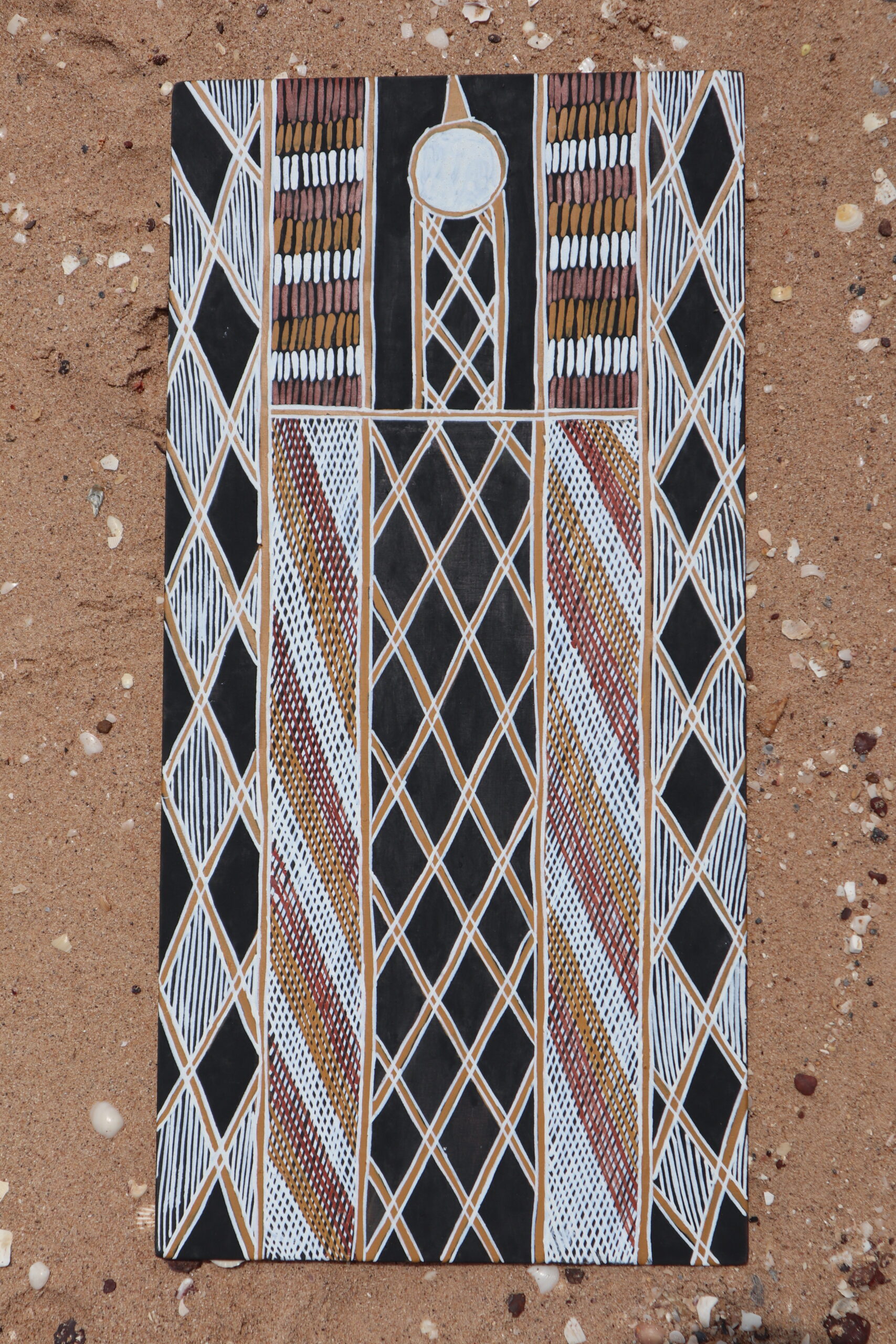
This painting is a unique and interesting variation on the foundational guku (native bee/bush honey) miny’tji (sacred clan design) that belongs to the Gupapuyŋu people of the Yirritja moiety.
An old black and white photograph of a painting of this design, originally taken by an early Mission art worker in the 60’s, was uncovered by the art centre’s Djalkiri Keeping Place (www.djalkiri.org) – a community access archive that repatriates and stores digital images of Yolŋu material culture that has been collected from Milingimibi over the last century. The photograph was shown to several senior Gupapuyŋu men, one of whom decided he wanted to paint it. “This painting has been asleep too long, we need to wake him up”, he explained.
As a primary clan design, the artist was well versed in the dhäwu (story), manikay (song cycle) and miny’tji (clan design) concerned, but this particular version presented an unusual combination of design elements. Furthermore, being a black and white photograph, the colour combinations used on the original were uncertain.
While clans usually have a prescribed range of colours that are used to paint their miny’tji according to clan law and ancestral jurisdiction, the combinations used in some elements or parts of a given miny’tji can be determined by each artist according to their creative choice, their willingness to innovate and the particular elements of a story or cultural idea they wish to focus on. Stylistic and structural depiction of a miny’tji is also flexible to individual taste and conceptual focus within certain frameworks. As with much Yolŋu storytelling and philosophy – miny’tji are contextual and applied with discretion depending on the mode of transmission and the audience.
This painting shows guku galanyin, which is the ‘nose’ of the hive that protrudes from the tree that hosts it and is where the honeybees come and go in their constant quest for food. This is depicted by the triangular ‘nose’ at the top of the painting, with a circular hole showing the doorway to the hive. Underneath this is the rumbal (body) of the hive, represented by the interlocking diamond pattern representing the honeycomb structure. The outside panels show the honeycomb filled with fresh flowing guku (honey), while the rärrk (cross hatching) in the internal panels also represents flowing guku (honey). Finally, at the top of the painting the coloured dash marks show the footprints and scratch marks of waṉ’kurra (bandicoot), another important totem animal associated with this Yirritja ceremonial cycle. Guku is also a favoured food for wan’kurra, who leave their footprints on the ground and claw scratch marks on trees in their pursuit of guku. Skilled hunters can spot and follow these tracks to lead them to guku hives. Perhaps the most unique design element of this painting is the use of black as a background, which is very rare.
Different variations of this design are painted on bodies at different stages of the Ŋärra men’s cleansing ceremony and Dhapi (‘making man’) ceremony. When the Ŋärra ceremony is finished, Yirritja participants dance to the salt water and are cleansed by people of the Dhuwa moiety who splash them, ritually washing the body paint off and fulfilling their ceremonial obligations according to yothu-yindi (mother-child) gurruṯu (kinship). Yothu-yindi is symbolic of the two divisions of the cosmos, Dhuwa and Yirritja, and all interdependent ceremonial relationships. Guku is also painted onto the body or the coffin of the deceased during bäpurru (mortuary rites) to identify them as Gupapuyŋu in the world beyond.
The artist has visited many collections held in museums and galleries around Australia and is a passionate advocate for reconnecting Yolŋu cultural heritage back with its community. Asked to reflect on this process of digital return and what this legacy means today, the artist said,
“Dhuwalanydja djalkiri dhiyaku art centre-w. Ga djalkiri nhanŋu dhiyak art centre-w yäna dhu ga dhärra bitjan bili dhu ga dhärra yan. Yaka dhu ŋayi dhuwal djalkiri ga gamunuŋgu wothirr dhu, yaka, wo burdju’purdjuyun. Dhuwali napurruŋgu dhuwal djalkiri. Dhärra yäna dhu ga bitjan bili. Dhuwala walala napurruŋgu djalkiri nhirrpara worru’wurruŋu yolŋuy mala, napurruŋgu Dhuwaw yolŋuw ga Yirritjaw yolŋuw. Dhuwala walala limurruŋgu nhirrpara: djalkiri, gamunuŋgu, ḻikan ga riŋgitj ga manikay.”
“This is the legacy of the art centre. The legacy of the art centre will continue forever. The foundations and these designs won’t be lost, no, they won’t be rubbed out. These are our foundations. They will be here forever. This is the legacy left to us by our old people, for us, Dhuwa and Yirritja people. This is what they put down for us: designs, identifying names, alliances and songlines.”