Description
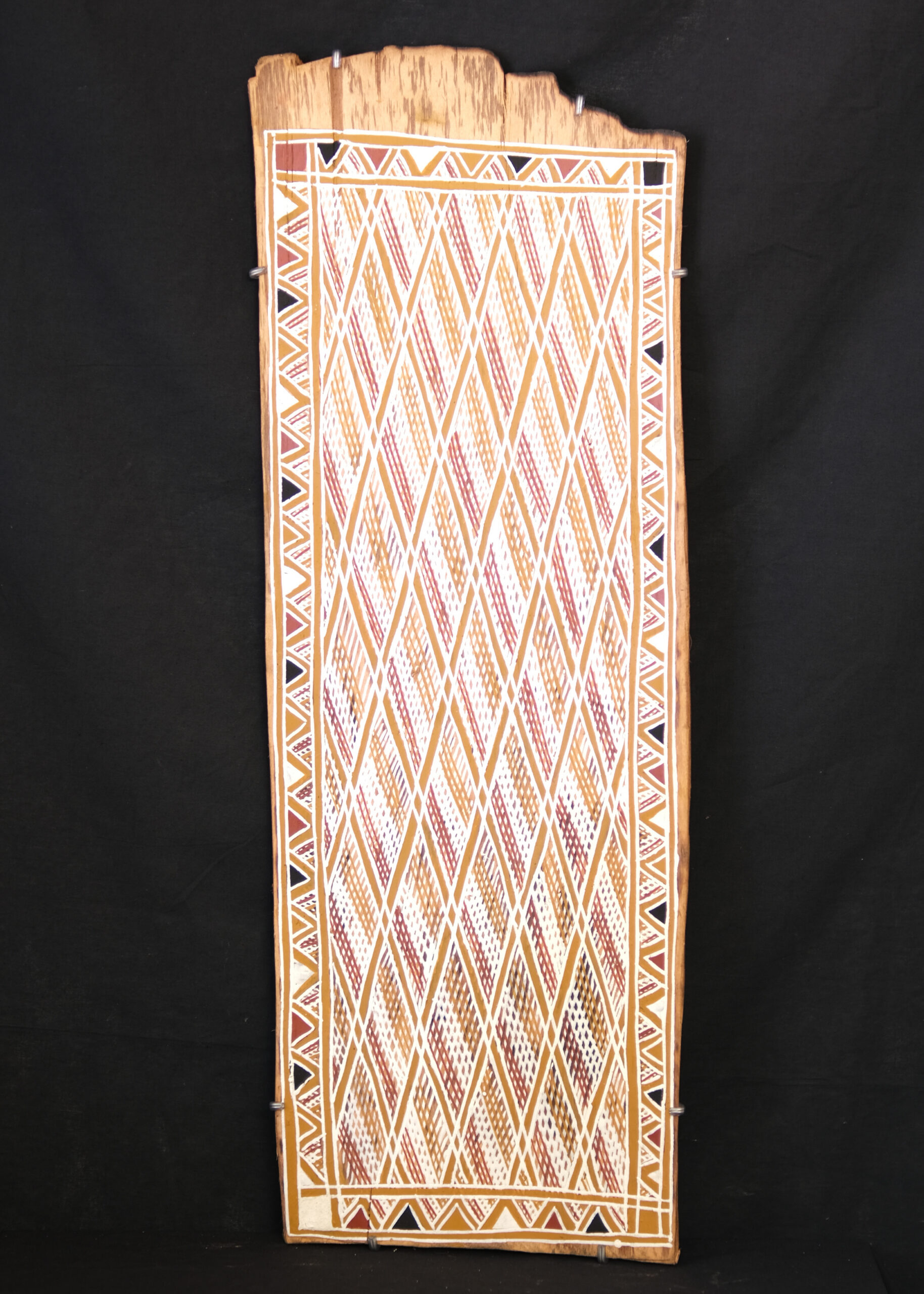
This painting depicts the ancestral meeting of the Gupapuyŋu and Warramiri clan totems Guku (native bee) and Wuymirri (whale). The encounter is remembered as a forging of bonds between the two clans and is celebrated today in ceremony through this painting and its songline and ceremonial dance.
For the artist and his Gupapuyŋu Ḏaygurrgurr clan, the story begins at their homeland of Djiliwirri, on the mainland south of Elcho island, when Guku first began their journey in search of nectar to make honey. The Gupapuyŋu ancestral bees followed the various trade winds that mark the Yolŋu cardinal directions, with one flying north over the sea to find a Warramiri saltwater place.
Far away it could see an island – a reef outcrop named Gaŋgirr Manbuyŋa Nyadawuku’ – but when Guku arrived there it turned out it was actually Wuymirri (whale). Wuymirri was lying belly-up, and Guku landed on it, leaving its guku design stamped on its belly – the diamond pattern that you see in the painting. Wuymirri then turned and spat out a spout of spray – symbolised by the triangular motif along the border of this painting – covering the bee in a white foam, and by doing so, made the Gupapuyŋu Guku sacred.
Guku then returned to Djiliwirri with this spray, associated with gapaṉ (white clay), and since this time, Gupapuyŋu people have applied gapaṉ to their face and throat in Ŋärra’ cleansing ceremony and Dhapi’ initiation ceremony. To do this, white clay is chewed and mixed with water before being ‘spat’ onto the subject – just as Wuymirri once did to Guku.
This transference – the reciprocal acts of ‘spraying’ and ‘stamping’ – is a magical and powerful act that is still said to be imbued with ancestral power. The word ‘guyukthun’, used by the artist to describe the act of ‘spraying’, simultaneously means ‘spurt water’, ‘make something sacred’ and apply paint’.
The artist, Joe Dhamanydji, explains,
Guku marrtji North, East, West ga South.. So ŋayi buṯthurr guku bala across to the ocean … ga nhäŋal ŋayi ŋunhal, yanbi island wo dhakal, yurr guḻundhu ŋayi gan ŋorran. Ŋayi buṯthun bala ŋayi (SLAP!) nhirrpanmirriny. Ga ŋayi nhäŋal gukuny ga ŋayi wuymirriy buku-guykthurr ŋayi ŋanya. So ŋayi dhiyaŋ gukuy gäŋalnha djiliwirrilil bala roŋanmaraŋalnha gamunungu yäku, nhawi gamunuŋgu yäku buḻumbuḻ.
The honeybees from Djiliwirri went North, East, West and South. So, one of them flew across the ocean and it saw what it thought was an island, but it was really the whale lying belly up. He flew there and – SLAP! – it attached to the whale’s belly. The whale saw the bee and it spat out at the bee’s head through its blowhole. So this bee brought back to Djiliwirri this foam as white ochre called buḻumbuḻ.
So ŋayi djaw’yurrdhi beŋur gäŋalnydja ŋayi Djiliwirrilil bala, balayi bili roŋanmaraŋal ṉunhi ŋayi nappurruny gurrupan dhiyaŋ wuymirriy for cleansing ceremony-w ga nhawiku napurru dhu gapu guwatjman ŋunha gapu napurr dhu buku guykthunmirr napurr dhu dhiyal ga waŋgany gurrupan dhapiwnha romgu — initiation-guny. Buku guykthun bala end of nhanŋu initiation-gu.
So it took the white foam from there and carried it to Djiliwiiri and that white ochre given by the whale is what we use at our cleansing ceremony for spitting out on each other [as a method for applying body paint], and we use it for the end of an initiation ceremony too. When we do that it marks the end of the initiation.