Description
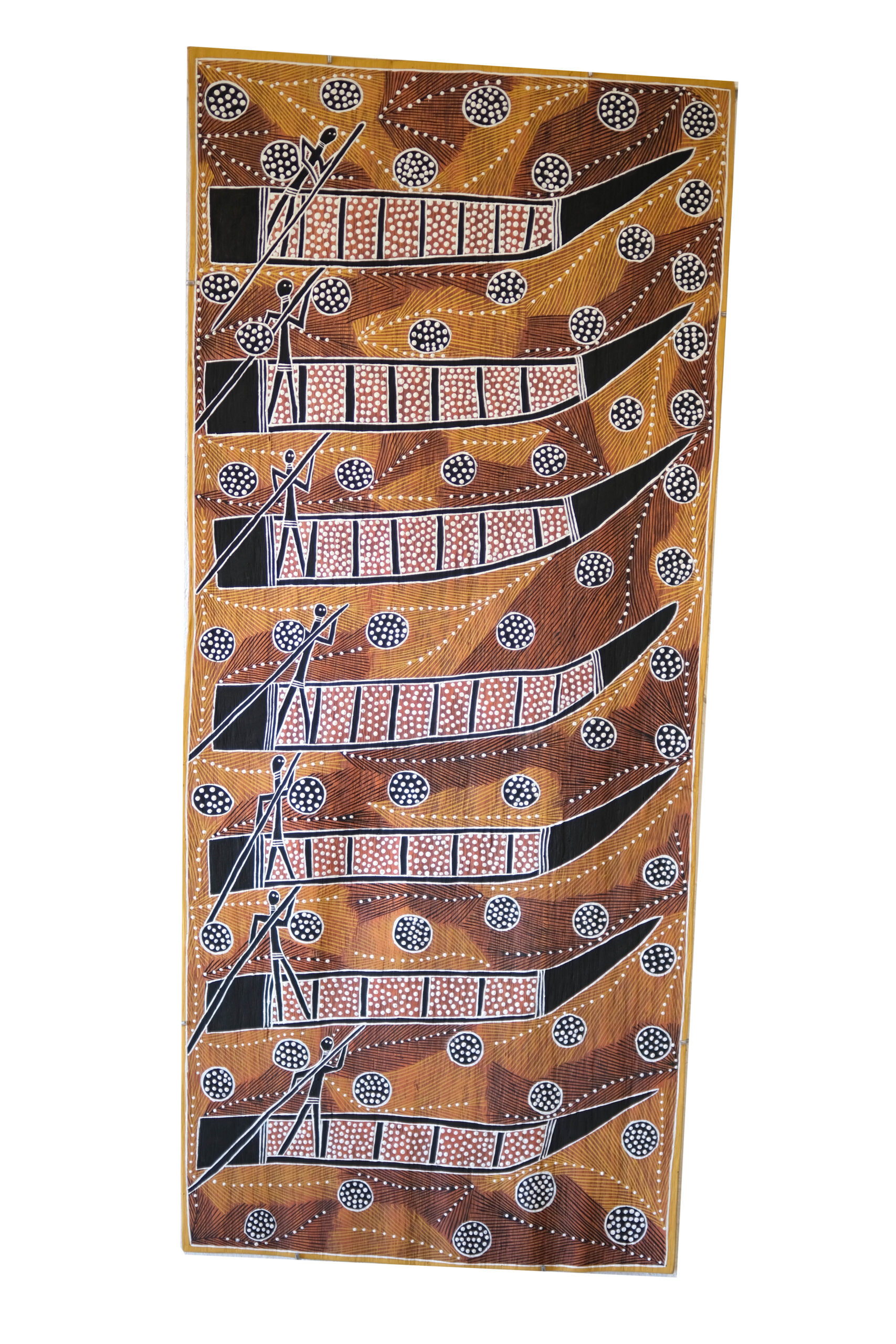
This painting belongs to Djipurrtjun’s Ganalbiŋu Malibirr clan and depicts the vast waters of Muwaŋgi, the Arafura Swamp, located south of Ramingining. Muwaŋgi is the largest wooded-swamp in Australia and a place known for its bird and freshwater marine life.
Pictured are the Ganalbiŋu Malibirr ṉaku (sewn bark canoe), which are used during the start of the wet season to collect the eggs of Magpie Geese and Saltwater Crocodile. Ṉaku have a distinctive shape with a bowed and pointy nose that pierces through the heavy grasses and sedges that grow in Muwaṉgi. These canoes were made famous in the Rolf de Heer film ’10 Canoes’, which was inspired by historic photos of the artists grandfather and other clansman while on hunting.
This painting, as opposed to much of the artist’s usual repertoire of ceremonial clan designs, is not associated with creation ancestors. The artist explains,
“I got this story from my märi-mu (paternal grandfather). It’s a history story. Me and my brothers got this, like a bed-time story from our märi-mu. We would lie down for sleep and he would tell us all the stories about egg hunting. That’s what we do. Ganalbiŋu mob, magpie goose mob.
Gurrumaṯtji are the focus point of Ganalbiŋu law and ceremony, with the clan also going by the name Gurrumba’kurrumba, meaning a literal flock of Magpie Geese
Djipurrtjun explains that the eggs are only available at the beginning of the wet season after the first rains have fallen and the mukuluk (spear grass) begins to grow: “We know when we see the mukuluk, fresh one, spikey… when he’s growing fresh and green we go get gurrumaṯtji mapu (magpie geese eggs). The white dots that fill the ṉaku are the eggs from these birds and the surrounding fine lines depict mukuluk, alongside rräkay, the freshwater grasses that full the swamp.
“I remember when I was a young boy with my märi-mu. We go out looking for goose eggs, crocodile eggs, long-neck turtles, duck eggs and water snakes – too many! We used those ṉaku, the bark canoe. My märi-mu would make them. Cut the bark and burn him to make the shape, sew it up at the front and back. Then we could get all that food. Too clever my märi-mu.”
Yiŋiya Mark Guyula, senior djuŋgaya custodian for the Ganabiŋu clan, grew up with his mother’s clan by the Arafura Swamp and is considered one of the foremost holders of Ganalbŋu law and language.
“This type of canoe is called ŋaḏan. It’s a light bark canoe, like a kayak, so that it can easily pass through reeds and other plants in the water and this is what separates it from the heavy dugout canoe. It has a sharp nose the seperates the reeds and lets us glide right through. This painting represents a history story showing how we live on country.”